

Recent attention surrounding PFAS limits in drinking water suggests a rapidly evolving regulatory landscape. In April 2024, the United States Environmental Protection Agency (EPA) finalized a national primary drinking water regulation (NPDWR) for select per- and polyfluoroalkyl substances (PFAS), providing long-awaited regulatory direction for water systems. However, subsequent litigation and actions from EPA, including new proposed rules, have left some utilities confused and others concerned that requirements could change while they execute compliance plans.
While coverage has focused heavily on potential changes, the existing regulation remains in effect today. This article discusses the EPA’s recent proposed rules in context with the existing rule and the ongoing litigation challenging it. Understanding each separately provides utilities important perspective as they continue working toward compliance.
Existing National Primary Drinking Water Regulation for PFAS
The 2024 NPDWR established federal drinking water standards for six PFAS compounds and introduced monitoring and compliance requirements for public water systems. The rule includes the following maximum contaminant limits (MCLs) for five PFAS:
- 4.0 parts per trillion (ppt) for perfluorooctanoic acid (PFOA) and perfluorooctane sulfonic acid (PFOS)
- 10 ppt for perfluorononanoic acid (PFNA), perfluorohexane sulfonic acid (PFHxS), and hexafluoropropylene oxide dimer acid (HFPO-DA, or GenX chemicals).
In addition to individual MCLs, the rule includes a formulaic hazard index approach for mixtures containing two or more PFAS compounds. Specifically, the hazard index applies to PFNA, PFHxS, HPFO-DA, and perfluorobutane sulfonic acid (PFBS), referred to throughout the article as “index PFAS.” A hazard index value greater than 1 indicates the mixture exceeds the regulatory threshold.
Under the current rule, public water systems must complete initial monitoring by 2027 and comply with all PFAS limits by 2029.
Legal Challenges to the PFAS Rule
Although the 2024 PFAS drinking water regulation is currently in effect, it remains the subject of ongoing litigation. Following EPA’s final PFAS rule, the American Water Works Association (AWWA) and the Association of Metropolitan Water Agencies (AMWA) filed a joint petition challenging the regulation on several grounds that may not align with the requirements established under the Safe Drinking Water Act (SDWA).
New Proposed PFAS Rules
In May 2026, the EPA proposed two rules that would change the NPDWR requirements. Notably, the proposed rules would maintain the existing MCLs for PFOA and PFOS, while rescinding index PFAS requirements and allowing a two-year compliance extension. Both are in line with EPA's 2025 announcement to uphold protection from PFAS in drinking water while offering utilities additional flexibility for compliance.
Two-Year MCL Compliance Extension for PFOA and PFOS
One proposed rule would allow qualifying water systems to request a two-year extension to the existing PFOA and PFOS compliance deadline, moving the deadline from 2029 to 2031. However, systems would still be required to meet monitoring and reporting requirements established under the 2024 regulation. All systems granted an extension must notify their customers and include sample results in consumer confidence reports.Additional requirements would apply to systems with PFOA or PFOS concentrations above 12 ppt. Those systems must implement two short-term mitigation efforts – choosing between six options that include point-of-use treatment, alternative water supply, source water protection, and public education – while working toward compliance.
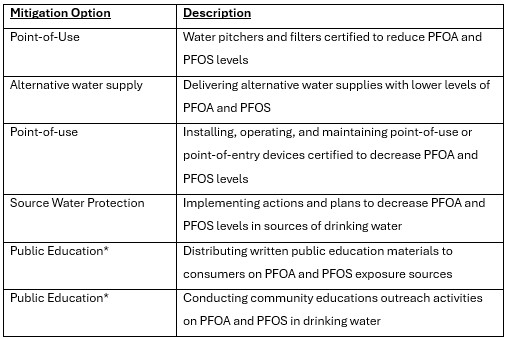
Proposed mitigation options for water systems seeking extensions with 12 ppt or greater of PFOA or PFOS. (*Systems may not select both public education options for their two measures.) Source: EPA FAQ for Proposed Compliance Extension Rule
Rescission of Regulations for PFHxS, PFNA, HFPO-DA, and HI Mixtures
The second proposed rule would rescind portions of the 2024 regulation that apply to the index PFAS. EPA has indicated that the sole reason for the rescission is to address concerns that the regulatory process used to establish those requirements did not fully align with SWDA procedures. The EPA will continue evaluating additional PFAS for future drinking water regulation.
Current State – Where Things Stand
Despite ongoing litigation and proposed regulatory changes, the final rule from April 2024 remains the only enforceable federal PFAS standard for drinking water. Public water systems are still required to complete initial monitoring by 2027 and meet applicable maximum contaminant limits and hazard index requirements by 2029.Much of the uncertainty surrounding PFAS regulation stems from confusion between proposed actions and enforceable requirements. EPA's May 2025 announcement signaled the agency's intent to pursue changes but did not alter existing compliance obligations. Likewise, the two proposed rules released in 2026 must still complete the federal rulemaking process before they can take effect.
The timeline for any final action remains uncertain. As a point of reference, the 2024 PFAS NPDWR was announced nearly 11 months following the close of public review and comment on the proposed rule. This illustrates the amount of time it could take to consider public comments and finalize a regulation.
The AWWA/AMWA litigation faced delays after EPA requested additional time, but oral arguments are scheduled for September. In the meantime, the existing rule remains in effect, and AWWA stresses that water systems should not delay compliance efforts.
Water systems considering future compliance extensions should also pay close attention to primacy, which is when a state, territory, or tribal agency takes responsibility for enforcing federal water quality standards. At the time of this writing, no entity with primacy has adopted the federal PFAS rule, but when it is adopted by a state, an EPA-granted compliance exemption would not transfer automatically. For that reason, water systems should maintain open communication with local authorities when navigating PFAS compliance strategies.
Moving Forward
For drinking water systems navigating PFAS compliance, the most important fact remains the same: the 2024 National Primary Drinking Water Regulation is currently the only enforceable federal drinking water rule for PFAS. While ongoing litigation may impact the existing rule, the EPA’s new rules are likely to reinforce the MCLs for PFOA and PFOS. Water systems hoping for extensions should work with local primacy agencies to understand possible implications when the federal rules are adopted into their existing programs.The index PFAS rule rescission will not have a significant impact. According to Corona Environmental Consulting, LLC, the UCMR5 data shows only six of 1,064 impacted water systems exceed the Index PFAS limits without also exceeding MCLs for PFOA or PFOS. In other words, PFOA and PFOS will drive the need for treatment.
Ultimately, the regulatory landscape surrounding PFAS standards may continue to evolve, but the time required for planning and executing treatment and other mitigation strategies requires immediate action. Water systems that focus on preparing for compliance under existing requirements will be best positioned to adapt as future regulatory and legal developments unfold.
When evaluating PFAS treatment options, contact Kurita to help you identify solutions that fit your compliance goals, whether you need to adapt an existing treatment system or design a new one.
References
AWWA PFAS Resources PageAMWA PFAS Litigation Information Page
AWWA/AMWA Statement of Issue
EPA Proposed PFOA and PFOS Compliance Extension Rule
EPA FAQ for Proposed Compliance Extension Rule
EPA Proposed Rescission Rule
Corona Engineering LinkedIn Post