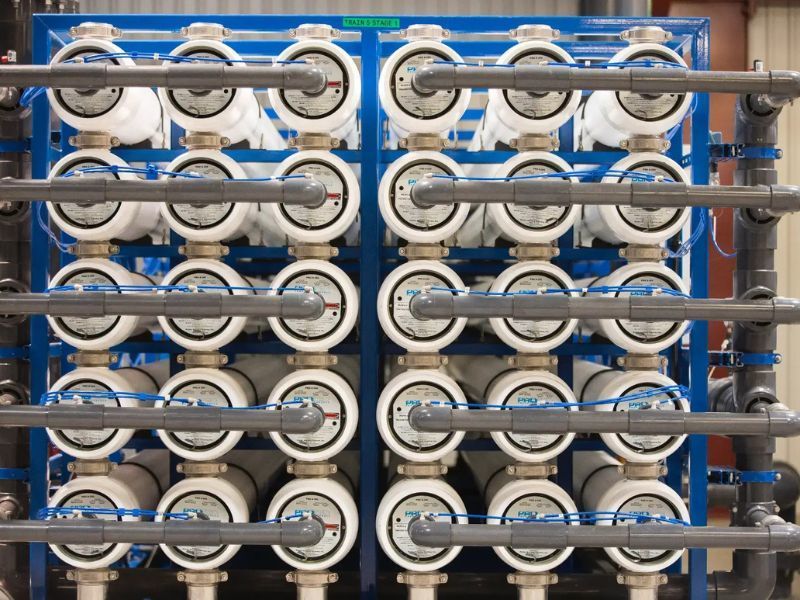
When you hear reverse osmosis (RO), you might think about the filter that people put in their homes to make the water taste better. That’s just one of the ways RO treatment can be used, even in a home. The municipal desalination Al Taweelah RO Plant in Abu Dhabi, United Arab Emirates produces up to 240 million gallons (909,200m³) of drinkingwater daily; this can be replicated, though not to the extent of Al Taweelah, in the industrial and commercial sectors too.
Since reverse osmosis is one of the most widely used water treatment technologies, this article breaks it down from the basic science to the real-world industrial applications and what it means for your facility.
What Is Reverse Osmosis?
Reverse osmosis is a water purification process that uses pressure and a semi-permeable membrane to remove dissolved salts, contaminants, and impurities from water. The resulting high-purity water meets the demanding standards of industrial and commercial applications.
To understand reverse osmosis, it helps to first understand regular osmosis. In nature, osmosis is the process where water moves through a membrane from a less concentrated solution to a more concentrated one, trying to equalize both sides. Examples of this include plant roots absorbing water from soil, or a raisin absorbing water and expanding when soaked.
Reverse osmosis, as the name suggests, reverses this natural process. By applying pressure to the water, you force it through the membrane in the opposite direction, leaving dissolved solids and contaminants behind. Think of the membrane like an extremely fine filter, so fine that water molecules can pass through, but dissolved salts, heavy metals, bacteria, and other impurities largely cannot.
How Does Reverse Osmosis Work?
An industrial-grade RO system typically moves water through several treatment stages before it reaches the RO membrane itself, so let’s take a step back before reaching that point. Here's how the process works:
Pre-Treatment
Before water reaches the membrane, it goes through pre-treatment steps to protect the system. This often includes sediment filtration to remove particles like silt, rust, and suspended solids, as well as carbon filtration to remove chlorine, which can damage RO membranes over time. Depending on the source water, chemical scale inhibitors or softening systems may also be used. Skipping or skimping on pre-treatment is one of the most common causes of membrane fouling and shortened system life as well as it could damage other equipment throughout a water system.
Keeping membranes clean and well-maintained is essential to extending asset life, controlling operating costs, minimizing waste, and ensuring consistent water quality. To achieve this, specialized treatment solutions are critical.
The RO Membrane
Then the water meets the core of the process: the RO membrane. Water is forced under pressure through the semi-permeable membrane. Purified water, called permeate, passes through and continues downstream. The concentrated stream of rejected contaminants, called concentrate or waste stream, is diverted away. Most industrial RO membranes can reject 95 to 99% of dissolved solids, depending on the system design and water source.
Post-Treatment
Depending on the end use, the purified water may go through additional polishing steps, such as a mixed bed demineralizer or second-pass RO to remove any remaining trace ions in the permeate for ultra-high-purity applications.
What Does Reverse Osmosis Remove?
Industrial-grade RO systems are effective at removing a wide range of contaminants:
-
Dissolved salts and minerals (measured as total dissolved solids or TDS)
-
Heavy metals such as lead, arsenic, and mercury
-
Bacteria and viruses
-
Nitrates, sulfates, and fluoride
-
Pesticides, herbicides, and pharmaceuticals (with additional GAC media polishing)
-
Silica
What Industries Use Reverse Osmosis?
Industrial RO systems are used wherever consistent, high-quality water is essential to the process or product. Common applications include
-
Power generation: RO is used to produce high-purity boiler feedwater. Dissolved minerals in boiler water cause scaling and corrosion, which reduces efficiency and can lead to costly equipment failures. RO removes those minerals before they become a problem.
-
Food and beverage: Product quality and safety depend on the quality of the water used in food and beverage production. RO helps manufacturers meet strict regulatory and quality standards.
-
Pharmaceuticals and life sciences: These industries require ultrapure water (UPW) for formulations, equipment cleaning, and laboratory use. RO is often the first step in a multi-stage purification train.
-
Microelectronics: Semiconductor manufacturing uses ultra-high-purity water for rinsing and processing. Even trace contaminants can ruin a batch of wafers, making RO essential.
-
Municipal water treatment: Many municipalities use RO as part of their treatment process, especially in areas with brackish groundwater or limited freshwater sources and for use in well or surface water sources that have exceeded the maximum contaminant levels (MCL’s).
-
Industrial manufacturing: From mining and steel to light and heavy manufacturing, RO is used to reduce the impact of impurities on equipment, cooling systems, and processes.
This is only the start of where RO units are used. Facilities, big or small, could invest in the first step of optimizing water operations.
What Are the Benefits of Reverse Osmosis?
For industrial and commercial operations, the benefits of RO go well beyond just cleaner water:
-
Equipment protection: Hard water minerals and dissolved solids are a leading cause of scale buildup in boilers, heat exchangers, and cooling systems. RO removes these contaminants before they cause damage, extending equipment life and reducing downtime.
-
Lower operating costs: Cleaner feedwater means your chemical treatment programs work more efficiently. In boiler systems, for example, higher-purity water allows you to run at higher cycles of concentration, which means less blowdown, less water waste, and lower chemical use.
-
Process consistency: Many industrial processes are sensitive to water chemistry. RO provides a reliable, consistent water quality regardless of what's happening with your incoming water supply.
-
Water reuse: Concentrated reject water from an RO system isn't always waste. In some applications, it can be redirected to other uses, reducing overall water consumption — an increasingly important goal for facilities focused on sustainability.
-
Regulatory compliance: Many industries face strict regulations on water quality and wastewater discharge. RO helps facilities meet those standards more easily.
What Are the Limitations of Reverse Osmosis?
RO is a powerful technology, but it's not a one-size-fits-all solution. A few things to keep in mind:
-
Pre-treatment is essential: Without proper pre-treatment, membranes foul quickly, driving up costs and reducing performance.
-
Reject water management: RO systems produce a concentrate stream that must be managed or discharged appropriately.
-
Energy use: Operating under pressure requires energy, though modern systems are significantly more efficient than older designs.
-
Not always the right first step: Depending on your water source and end use, RO may need to be part of a larger treatment system rather than a standalone solution.
A water treatment partner with experience in RO system design, operations, and treatment can help you evaluate how to integrate it effectively into your operation.
How Is Reverse Osmosis Different from Other Filtration Methods?
It's worth distinguishing RO from other common water treatment technologies:
-
Standard filtration removes particles and suspended solids but doesn't remove dissolved salts or most chemical contaminants.
-
Softening removes hardness-causing minerals like calcium and magnesium through ion exchange but leaves behind other dissolved solids.
-
Ultrafiltration (UF) removes bacteria, viruses, and larger particles but doesn't remove dissolved salts.
Reverse osmosis goes further than all of these, removing dissolved salts and a wide range of chemical and biological contaminants at a molecular level.
In many industrial systems, these technologies work together. A softener might be used upstream to protect the RO membrane, while RO handles the dissolved solids, and a UV system downstream handles any residual microbiological concern.
Putting It All Together
Reverse osmosis water treatment is one of the most effective and versatile tools in industrial water management. Whether you're protecting a boiler system, meeting food safety standards, or producing ultrapure water for a precision manufacturing process, RO can play a critical role.
That said, every process is different. Water source quality, flow requirements, downstream processes, and discharge regulations all affect how an RO system should be designed and operated. Getting it right from the start with proper pre-treatment, the right membrane selection, and a solid maintenance program makes a significant difference in long-term performance and cost.
Ready to explore whether RO is right for your facility? Contact Kurita today.