

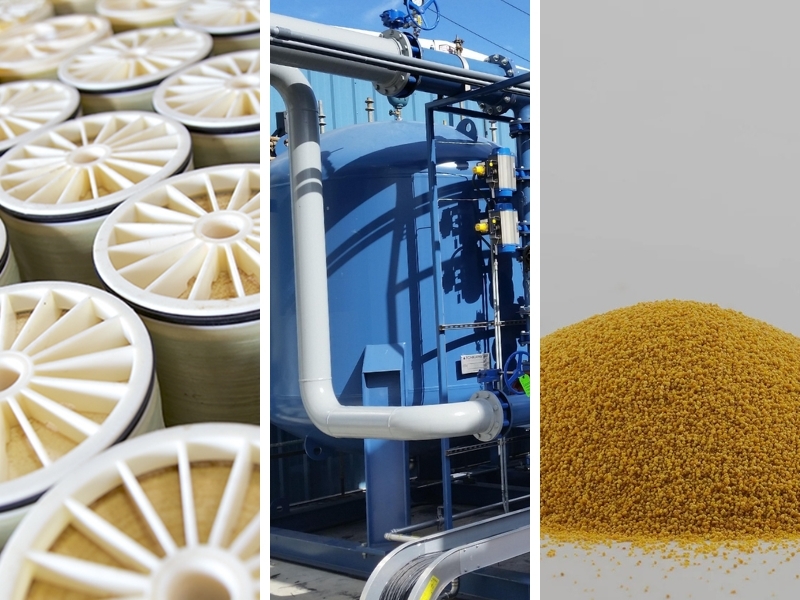
Many facilities find that removing PFAS is the easier part of the problem. The harder part is picking a technology that will still work and still make financial sense ten years from now. Per- and polyfluoroalkyl substances (PFAS) are a large family of synthetic chemicals that persist in the environment and build up in the body. This article compares the main PFAS treatment technologies and also explains how water chemistry, flow rate, and regulatory targets should guide your choice while covering how to remove PFAS from water and what happens after capture.
What technologies remove PFAS from water?
The United States Environmental Protection Agency (EPA) lists granular activated carbon (GAC), ion exchange (IX), reverse osmosis (RO), and nanofiltration (NF) as the best available technologies for meeting federal PFAS drinking water limits. However, facilities aren't required to use these technologies, and newer options are gaining ground. In practice, how to remove PFAS from water depends on matching water quality to the right PFAS treatment technologies and planning for residuals management, including PFAS destruction technologies.
How do the main PFAS treatment technologies compare?
GAC
GAC is the most studied and most used PFAS treatment technology. Tiny pores give carbon a large surface area where PFAS molecules attach, so granular activated carbon PFAS solutions can remove more than 99% of long-chain PFAS when the contact time is long enough. GAC performance drops sooner for short-chain compounds, which often set the changeout schedule.- Where it works well: Water dominated by long-chain PFAS and facilities that already run carbon systems
- Where it struggles: Short-chain compounds break through sooner and natural organic matter competes for sites, reducing capacity for PFAS.
IX
Ion exchange resins carry a positive charge that attracts and holds negatively charged PFAS molecules. Ion exchange has rapid kinetics, so PFAS systems need shorter contact times and often treat more water before breakthrough than GAC.- Where it works well: Limited space, a broad mix of PFAS that includes short-chain compounds.
- Where it struggles: higher media cost, sensitivity to water chemistry, and residuals handling.
RO and NF
Membranes prevent the passage of PFAS molecules and concentrate contaminants into a reject stream that may require management alongside PFAS concentration or destruction technologies.- Where it works well: Water reuse, high-purity process water, and multi-contaminant removal
- Where it struggles: Energy use, pre-treatment needs, and reject concentrate handling
Novel adsorbent media
A newer group of engineered adsorbents is built to target PFAS specifically, and some can be regenerated and reused. Large pilot programs now test these media side by side with GAC and IX. The most notable options include- Cyclodextrin-based polymers. Cyclodextrins are ring-shaped sugar molecules made from plant starch. The best-known commercial example is Cyclopure's DEXSORB®, which is made from corn-derived beta-cyclodextrin. DEXSORB binds PFAS selectively by molecule size, which reduces competition from natural organic matter, oils, and dissolved ions.
- Surface-Modified Clay adsorbents. Natural clays are inexpensive and widely available. When their surfaces are chemically modified, as with CETCO’s FLUOROSORB® media, they become far more effective at attracting PFAS while resisting co-contaminants. Researchers group these "functional clays" with other promising alternatives to conventional media.
What happens to PFAS after it's removed?
Removing PFAS from water doesn't make it disappear. Every capture technology leaves behind a residual that holds the PFAS it removed: spent carbon, spent resin, membrane concentrate, or regenerant solution. Federal guidance names spent filters, membranes, resins, and granular carbon among the PFAS-containing materials that need careful handling. For a facility, how residuals will be managed should be decided when the technology is chosen, not after the system is running.What facilities need to plan for
- Know your residual streams. Identify what each technology will leave behind, how much, and how often. Spent media from single-use adsorption systems creates a solid waste with concentrated PFAS, while regenerable media and membrane systems produce liquid wastes with a range of concentrations. Disposal and destruction options vary depending on type of waste.
- Concentrate before you dispose. Shrinking the volume of liquid wastes, especially RO concentrate, through an additional concentration step makes it cheaper and easier to dispose of or destroy.
- Document the chain of custody. Track where residuals go and how they're handled and ask for verification of destruction where it's available. Perfluorooctanoic acid (PFOA) and PFOS are now designated as hazardous substances under the Comprehensive Environmental Response, Compensation, and Liability Act (CERCLA). That makes documentation a key part of managing long-term liability.
- Budget for the full lifecycle. Over a system's 20-year life, residuals management can turn into one of the hardest costs to justify. Include disposal and destruction costs when comparing technologies.
Can PFAS be destroyed?
PFAS destruction takes extreme conditions. The carbon-fluorine bond is among the strongest in chemistry, and a dense shield of fluorine atoms protects the PFAS molecule.How it's managed today. The EPA's interim guidance focuses on three large-scale options: thermal destruction, landfills, and underground injection into deep wells. In the U.S., Canada, and Europe, regulators are increasingly favoring verified destruction over long-term containment.
What's emerging. Several technologies exist to destroy PFAS by creating harsh environments, but commercialization readiness varies. Electrochemical oxidation is one of the furthest along, which leverages an electric current across an anode that creates oxidative species that break PFAS apart. Supercritical water oxidation (SCWO) is gaining ground and causes rapid oxidation and molecular destruction in a supercritical phase environment. Hydrothermal alkaline treatment (HALT) leverages alkaline catalysts under increased pressure and temperature to drive hydrolysis and ultimately defluorination. Other technologies leverage plasma, and some are UV based with additional chemistry to create hydrated electrons and reductively destroy PFAS.
A common trait among destruction technologies is energy intensity, and waste should be concentrated into the smallest volume possible for efficient destruction. Moreover, destruction technologies will not replace separation processes as standalone treatment options because they are not practical on large volumes of raw water with relatively low concentrations.
How do you choose the right PFAS treatment technology?
Choosing a technology is an engineering decision built on data, and most facilities will need outside help to make it well.
1. Start with a system audit. Map where PFAS enters your facility, which water streams contain it, and how existing equipment affects it. Sample the water to identify which PFAS are present and at what levels, and measure the factors that could affect treatment, such as pH, TOC, and hardness.
2. Run a feasibility assessment. Screen the technologies against your water chemistry, flow rate, available space, treatment targets, and residuals planning. Compare capital costs alongside long-term operating and disposal costs, not just the price of equipment.
3. Test at bench scale. Rapid small-scale column tests (RSSCTs) assess adsorptive media in a short time frame, simulating months or years of full-scale operation in a few weeks. They offer a low-cost way to evaluate multiple media types and determine the best solutions to consider further.
4. Pilot on-site. Field pilots can take months to years but give the most accurate prediction of full-scale performance because they capture any changes in water quality over time. Pilot data also shows when PFAS starts breaking through, which sets media replacement schedules and supports permitting. Pre-treatment may also be assessed to see if removing co-contaminants could reduce operating costs by extending media life.
5. Plan for change. PFAS science and regulations are still evolving. Experts favor approaches that can adapt as better technologies emerge.
PFAS treatment is rarely a one-time purchase. It's a long-term commitment, and the choices made today will shape a facility's operating costs, waste streams, and compliance position for years. GAC, IX, membranes, and novel adsorbents can all remove PFAS when they're designed well. The best fit depends on what's in your water, how much of it you treat, which limits you need to meet, and what you'll do with the PFAS once it's captured.
Facilities with the most success treat PFAS as a lifecycle challenge rather than just a filtration problem.
Choose a partner for the full lifecycle
Kurita supports facilities through every stage of the PFAS lifecycle and offers a variety of PFAS treatment and removal systems based on your goals. Through its cradle-to-grave service model, Kurita destroys captured PFAS with verified technologies and provides a certificate of destruction.Ready to evaluate your PFAS treatment options? Talk to a Kurita PFAS expert.