

If you manage a cooling water system, you've probably heard the term cooling tower blowdown, but what does it actually mean and why does it matter?
Below, we answer the most common questions about blowdown in cooling tower systems, so you can keep processes running smoothly.
What Is Blowdown in a Cooling Tower?
Because water evaporates in a cooling water tower, the leftover minerals and dissolved solids start to concentrate. Cooling tower blowdown is the controlled discharge of a portion of that water to flush out concentrated minerals and keep the system in balance. Think of it like draining a small amount of water from a fish tank to keep conditions healthy, except the stakes are higher and the system is much bigger.
Why Is Controlling Blowdown So Important?
With too little blowdown, minerals build up fast, causing scale, fouling, and rising energy bills. Too much blowdown and you're wasting water, chemicals, and money. The goal is to find the right balance.
Proper blowdown in cooling tower systems keeps a key metric in check called cycles of concentration (COC), which is the ratio of dissolved solids in the circulating water versus the makeup water. Staying within your target COC range means cleaner heat exchange surfaces, lower energy use, and more effective water treatment chemistry.
Water supply and wastewater discharge rates vary considerably by region but consider this simple example:
A customer has a 750-ton HVAC cooling system, operating 12 hours per day 250 days per year. The graph below illustrates the differences between operating at various increased COC and estimated water costs of $4.25/1000 gallons of supply water and $9.50/1000 gallons for discharged wastewater.
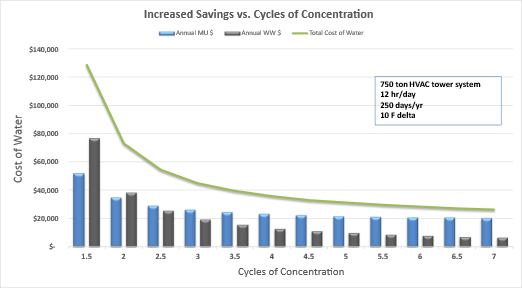
Beyond cost savings, well-managed blowdown also supports sustainability goals by reducing freshwater consumption and wastewater discharge.
How Do You Calculate Cooling Tower Blowdown?
There are two common methods:
- COC-based formula: If you know your evaporation rate and target COC, you can estimate blowdown with this equation:
Blowdown ≈ Evaporation ÷ (COC − 1)
As a rough guide, evaporation is about 1% of the recirculation flow for every 10°F (-12°C) of cooling range.
- Meter-based water balance: With flow meters on your makeup and blowdown lines, you can calculate:
Blowdown = Makeup − Evaporation − Drift
This method is more accurate when good metering is in place.
Makeup water quality (hardness, silica, chlorides), your system's metallurgy, and any local discharge limits can affect your blowdown requirements. For example, higher-quality makeup water usually allows you to run at higher COC, which means less blowdown and lower water costs.
How Often Should Blowdown Occur?
Most modern cooling systems use conductivity-based blowdown control rather than a fixed schedule. Here's how it works: a sensor continuously monitors the conductivity of the circulating water, which rises as dissolved solids concentrate. When conductivity hits a set threshold, a valve opens automatically to discharge water until the level drops back into range.
In practice, this means blowdown may be nearly continuous during hot, high-load periods and infrequent during cooler, lighter-load times. Automatic control is more efficient and precise than manual or time-based approaches.
What are Typical Cycles of Concentration for a Cooling Tower?
Most HVAC cooling towers operate between three and six cycles of concentration. With the right pre-treatment, such as softening or reverse osmosis (RO), and the use of Kurita’s high efficiency polymers, some systems can safely run at seven to ten cycles. High silica or chloride levels, on the other hand, may require staying on the lower end to avoid scaling or corrosion.
Can Cooling Tower Blowdown Water Be Reused?
In many cases, cooling tower blowdown water can be reused as long as it meets local regulations and facility water quality.
Cooling tower blowdown water is sometimes reused for non-potable purposes like irrigation, equipment washdown, or even as a feed source for RO membrane systems. Additional filtration and biocide treatments may be required to meet reuse standards.
Always check permit requirements and make sure proper backflow protections are in place before setting up any reuse system.
How Can You Tell if Blowdown Is Working Correctly?
Blowdown control is essential for stable system performance. Signs that cooling system efficiency is well managed include
- Conductivity and COC maintained within the recommended target range
- No upward drift in heat exchanger approach temperatures, indicating loss of heat transfer
- Corrosion coupon rates within acceptable limits
- Microbiological counts under control
If you notice scale buildup, rising energy use, or treatment chemistry that seems less effective, it may be time to review your blowdown setpoints and COC value. Routine lab testing provided by your treatment vendor helps validate that your control program is dialed in.
Putting It All Together
Understanding what blowdown in a cooling tower is and managing it well are effective ways to protect your equipment, lower operating costs, and support water conservation goals. Whether you're optimizing an existing system or setting up a new one, the right combination of monitoring, chemistry, and automation makes a big difference.
Start with reliable conductivity control, validate your COC regularly, and don't overlook water quality factors like silica that can sneak up on you. A well-tuned blowdown program pays for itself many times over.
Contact Kurita to update your cooling water system.